Living Donor Liver Transplantation
As of 2024, our hospital is the only one in Kanagawa Prefecture performing liver transplants for adults. Given the social background of Yokohama being a designated city with the largest population in the country, we accept patients with acute or chronic liver failure and Child C liver cancer from hospitals within Kanagawa Prefecture and affiliated hospitals who require liver transplantation.
Indications for Living Donor Liver Transplantation
Our hospital accepts living donor liver transplant recipients who meet the following criteria:
▶ Under 70 years old
▶ No drug addiction
▶ No organ failure in 2 or more organs excluding the liver
▶ No active infection
▶ No pulmonary hypertension
▶ For liver cancer, within Milan criteria (single lesion 5 cm or less, or 3 or fewer lesions 3 cm or less) or 5-5-500 criteria
▶ No progressive malignant tumor outside the liver
Donors must be between 18 and 65 years old, and within the third degree of kinship.
Underlying Disease
The breakdown of underlying diseases for patients who underwent living donor liver transplantation at our hospital is as follows: Hepatocellular carcinoma (n=15), Hepatitis B cirrhosis (n=14), Fulminant hepatitis (n=14), Primary biliary cirrhosis (n=10), Hepatitis C cirrhosis (n=6), Alcoholic cirrhosis (n=6), Primary sclerosing cholangitis (n=2), Autoimmune hepatitis (n=2), Biliary atresia (n=2), Other (n=4).
Treatment Results and Postoperative Management
In 2023, a total of 3 living donor liver transplants were performed.
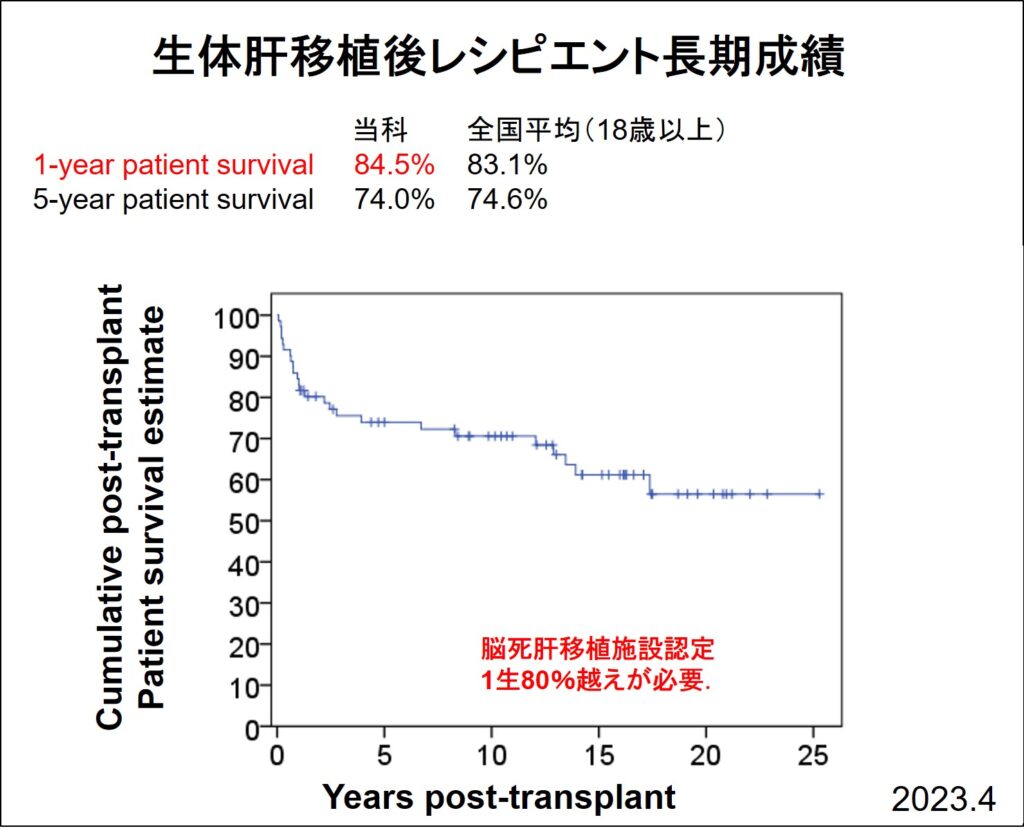
Our department's liver transplantation program began in 1997, and as of December 2023, a total of 75 cases have been performed. The 1-year survival rate is 84.5%, and the 5-year survival rate is 74.0% (figure below), which is comparable to the national average for adult living donor partial liver transplantation. Furthermore, among the 30 cases of living donor liver transplantation performed since 2012, there were 2 in-hospital deaths (6.7%), indicating an improvement in treatment outcomes compared to before 2012.
Our hospital's characteristic postoperative management includes the following initiatives, aimed at improving postoperative treatment outcomes for transplant patients:
① Pre-operative rehabilitation by the Rehabilitation Department.
② Pre-operative dental examination by the Oral Surgery Department.
③ Introduction of pre-operative symbionts.
Precise Surgery through Detailed Preoperative Image Evaluation
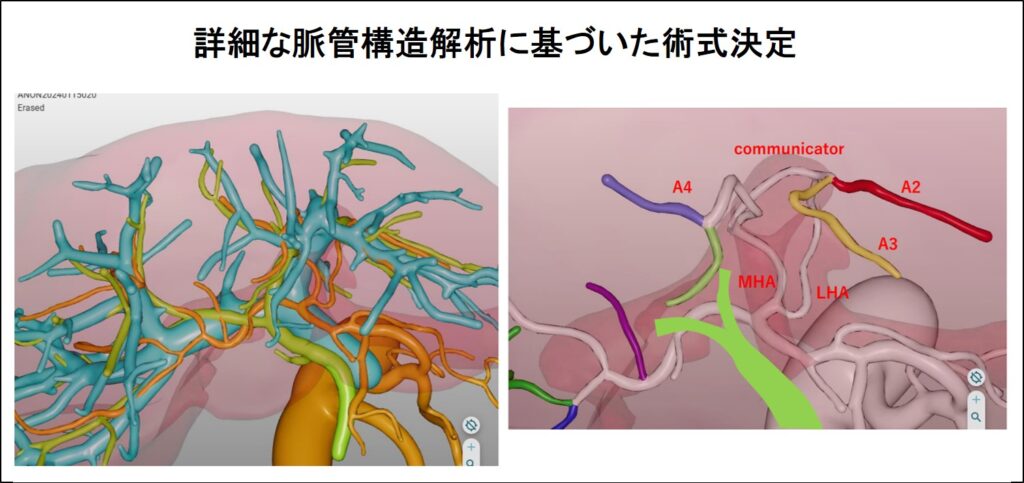
The liver not only has significant variations in shape and size among individuals, but its internal vascular distribution is also extremely complex. To perform safer and more reliable treatments and surgeries, it is necessary to sufficiently consider the shape, size, internal vascular distribution, and disease information of the liver for surgical patients.
Our department collaborates with MeVis, a German company, and aims for more precise surgical treatment by visualizing the extracted results of each blood vessel tailored to each patient, using a combination of image processing methods and manual intervention.